Showing posts with label Penguin. Show all posts
Showing posts with label Penguin. Show all posts
Sunday, November 22, 2020

Saturday, April 18, 2020
Doozy! Only two bugs left.

As
James Whittaker wrote in “Exploratory Software Testing”, bugs
tend to congregate for a variety of reasons such as complexity of the
code, skill of the assigned developer, number of
bugs in the past, etc. To make it short; where you see one bug there
are likely more near around. You just need to look for them.
Friday, November 29, 2019
Technical Debt not close-to-balance

I think it is normal in a project to accumulate technical debt somehow. You may have tough deadlines or other reasons to tend get things done more quickly than usual, probably with the mindset of getting it right later.
Other reasons for (quick) workarounds are new awareness (more experience) of how things work better under certain circumstances. The old approach was good for one particular problem, but not good enough for a general solution.
An increasing number of developers working on the same project may force the architect to enforce new coding guidelines or best practices for typical software development problems.
The use of embedded third party software may also trigger changes on your side when updates are delivered.
Technical debt should be avoided as much as possible and yes, there are scenarios where you are simply forced to live with technical debt. But, one should always be aware that, often, the time to improve old code won't be availble. Even if there will be such time, think about the risk of removing technical debt. Someone who works under pressure not only tends to seed ugly workarounds, but he is likely also adding sloppy unit tests (if he adds any at all). If that's the case, removing technical debts with refactored code adds new risks breaking functionality you won't know about until the customer reports them.
Monday, October 8, 2018
Banksy was here
 Sotheby's in London has auctioned off a framed version of Banksy's iconographic subject "Girl With Balloon" for over 1 million pounds.When the final bid was made, the big surprise came. Suddenly the screen moved down and the picture was destroyed by a shredder built into the picture frame [nyt]. Right after the surprise, the anonymous artist had published a video detailing how he installed a shredder into the frame [ban].
The disturbing part of this story is that this picture has probably gained even more fame through this action and thus very likely becomes more coveted although shred in pieces; volitional or not, Sotheby's to be in the known or not, the buyer well-informed or not....who knows.
Sources:
[nyt]
https://www.nytimes.com/2018/10/06/arts/design/uk-banksy-painting-sothebys.html
[ban]
https://www.instagram.com/p/BomXijJhArX/?utm_source=ig_embed&utm_campaign=embed_video_watch_again
Wednesday, September 26, 2018

Thursday, September 20, 2018

Thursday, June 28, 2018

Thursday, February 22, 2018
Unequal conditions

Tuesday, January 2, 2018

Saturday, December 30, 2017
Knowing your dress size

It later turned out it was Jon (anonymized) who accidentally took it, but
seemed not to realize this jacket was far too big for him. His height was
quite a bit different from the owner’s.
The cartoon is a metaphor on what happens
sometimes when companies start introducing UI test automation. You buy an
expensive tool only to find out, what you want to automate is not supported or
requires expensive add-ons. At the worst, one needs to hire experts to develop extensions,
so the tool works well with the AUT (application-under-test). Of course, these
extensions need maintenance and maintenance is seldom for free. I am not starting a debate about what's best, open source or off-the shelf. This
answer can only be given in a context which we don't have here. But I strongly
believe that it’s no bad practice to first start with a cheap or an open-source solution which fits your current "dress size" and
which lets you experiment, and develop more specific ideas to learn better what
you really need. Having enough time to explore helps you narrow down your
requirements catalogue. You are growing with the experience you make and after
a while you may end up realizing the current "jacket" no
longer fits or needs some boosters. It may also be the right moment to
restart the tool evaluation and look for a more suitable "jacket"
that fits your new dress size, but at least you do this now with a more
specific background - which is knowing your dress size.
Thursday, December 28, 2017
Life as a Software Tester

But honestly, I hope this is just a funny myth since I also built things successfully that are used by a large group of people worldwide. Maybe I just look at things a little bit differently. I love the speaches, articles and books of James Whittaker, Dorothy Graham, Johnathan Kohl and many many more; I am hungry to learn from them on a continuous basis and apply some of these techniques to my daily work with pleasure. Even at home I keep myself busy with software testing matters whenever the time allows me to. This is what the cartoon expresses here.
It all started more than 20 years ago with test automation, developing and running automated UI and B2B tests, using tools such as Rational Robot, SOAPUI, InCisif, WatiN, Selenium (and my team also used Ranorex), integrated in CI with Jenkins and I totally love home-brew solutions developed in C# like the recently newborn keyword driven test automation framework which is (at least for me) the next generation of another great Excel based test automation tool we used at an earlier company. Why C#? Sorry, - I am not a Microsoft advocate but MS Visual Studio is simply one of the best IDEs I have ever seen.
I also love tools like PerlClip, AllPairs, KDIFF3. I love to test through the side-door and last but not least...
I love to draw cartoons about software testing, my way of expressing weird experiences into something more exhilarant.
Wednesday, October 18, 2017
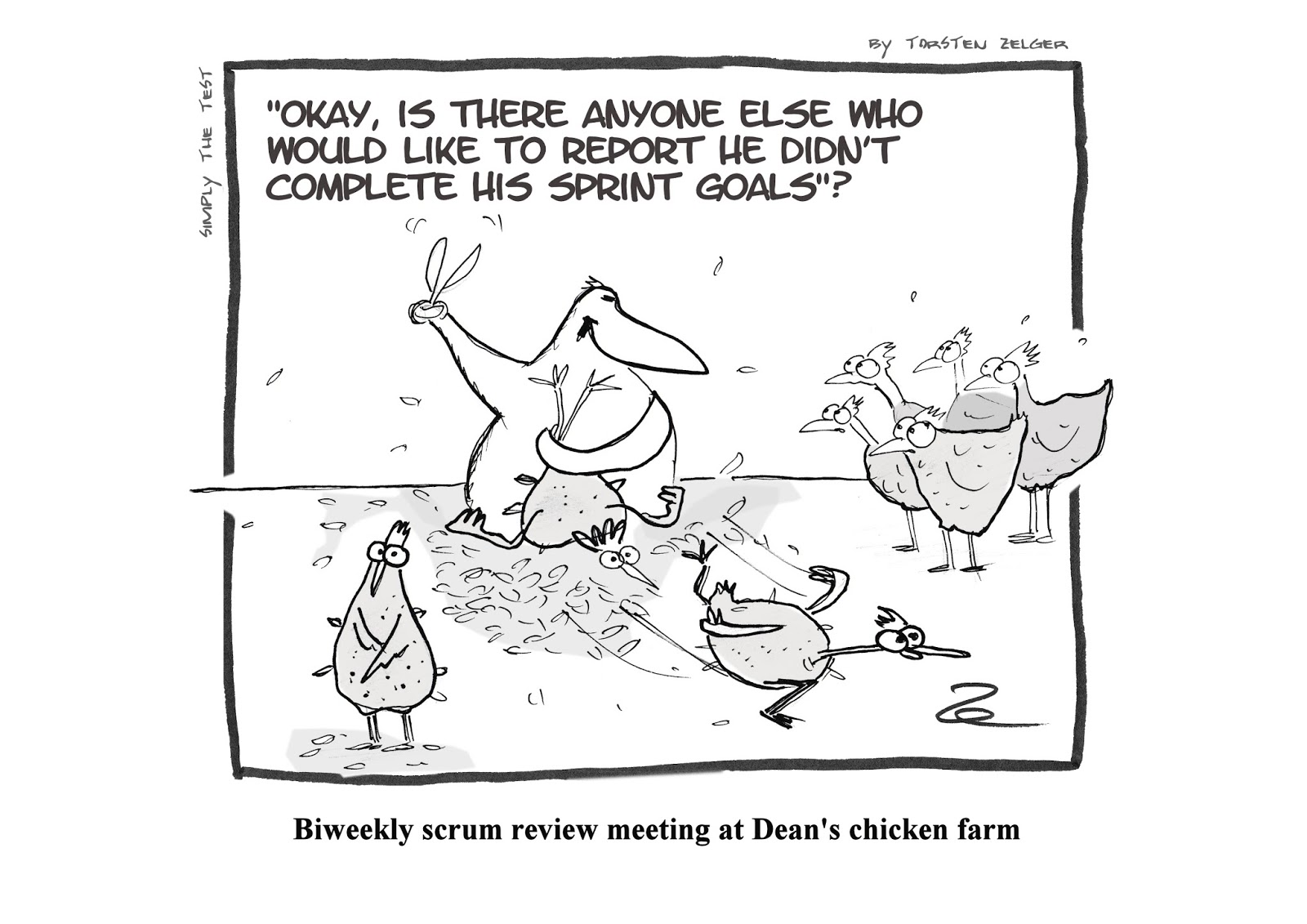
Scrum Review Meeting
Saturday, September 16, 2017
Stand-Up meeting in Antarctica

Sunday, July 9, 2017
Climate Warming

The cartoon's draft was drawn during a very long meeting where the subject had no direct relationship to this cartoon. But the more I think of it, the more it suits to the current technology transformation my teammates are going through.
In late 2022, I reworked the cartoon.
Saturday, May 28, 2016
Rainy Spring Season

Monday, May 9, 2016
Testing the Count Down

I have no idea what was the original purpose of this announcement and the following up emails and I doubt that professinoal engineers can be impressed by such statements. Anyhow, this story inspired me for the cartoon, but if you are a software developer or test engineer then you probably draw a relation to a typical situation in software development.
A funny fact in programming is that arrays start at index 0 and not 1 for many popular programming languages (eg. C++,C#, Java, Perl, JavaScript) and the last position in the array is indexed as Array-length minus 1. This fact sometimes causes troubles and confusion and it isn't a rare scenario where developers introduce bugs because of that.
Consider the following piece of code which would cause the program to skip the first element of a list. It starts reading at position 1 (which is actually the second) instead of 0.

Sunday, January 31, 2016

Thursday, December 31, 2015
Performance Testing applied

Wednesday, May 6, 2015

Friday, September 14, 2012
Everyday life at the Southern Hemisphere

My daughter askmed me whether I drew the Orca straight out of my head. Of course, NOT. I cannot draw an orca just like this out of my head. I googled the web to understand the most important characteristics, then did two drafts and this is what came out. If I didn't do that, I'd definitly missed the white spots and put the eye at the wrong place. Below you see the "final" before I scan it into the computer and the very first draft.

Final version before scanning into computer

Very first draft
Subscribe to:
Posts (Atom)