Showing posts with label software. Show all posts

Wednesday, December 31, 2025

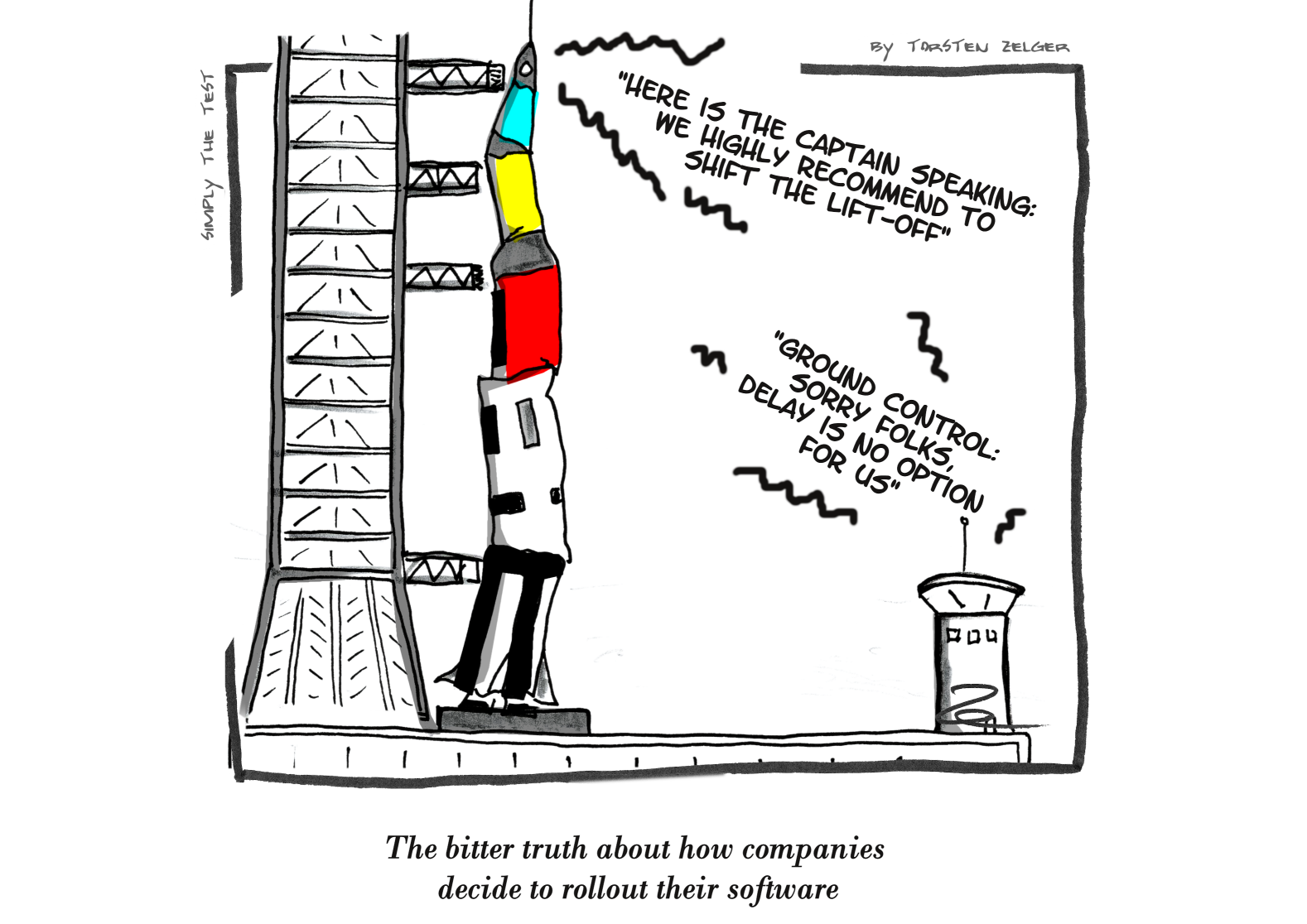
See you next year


Some facts about my cartoon blog:

- 8000 clicks per month 
- 500'000 (far more) in total 
- most of the visitors are from USA, Asia and South America.

No ads on the blog by purpose. 

Please note, if you are using one of the cartoons for personal use, you are free to do so, but if you use them commercially, you must ask for permission. It's just fair. ThanX.

Wednesday, October 2, 2024

The Birthday Paradox - and how the use of AI helped resolving a bug

While working / testing a new web based solution to replace the current fat client, I was assigned an an interesting customer problem report.

The customer claimed that since the deployment of the new application, they noticed at least 2 incidents per day where the sending of electronic documents contained a corrupt set of attachments. For example, instead of 5 medical reports, only 4 were included in the generated mailing. The local IT administrator observed the incident to happen due to duplicate keys set for the attachments from time to time.

But, they could not evaluate whether the duplicates were created by the old fat client or the new web based application. Both products (old and new) were used in parallel. Some departments used the new web based product, while others still stick to using the old. Due to compatibility reasons, the new application inherited also antiquated algorithms to not mess up the database and to guarantee parallel operation of both products.

One of these relicts was a four digit alphanumeric code for each document created in the database. The code had to be unique only within one person’s file of documents. If another person had a document using the same code, that was still OK. The code (eg. at court) was used to refer to a specific document. It had to be easy to remember.

 At first, it seemed very unlikely that a person’s document could be assigned a duplicate code. And, there was a debate between the customer and different stakeholders on our side.
The new web application was claimed to be free of creating duplicates but I was not so sure about that. The customer ticket was left untouched and the customer lost out until we found a moment, took the initiative and developed a script to observe all new documents created during our automated tests and also during manual regression testing of other features. 

The script was executed every once an hour. We never had any duplicates until after a week, all of a sudden the Jenkins script alarmed claiming the detection of a duplicate. That moment was like Xmas and we were so excited to analyze the two documents. 

In fact, both documents belonged to the same person. Now, we wanted to know who created these and what was the scenario applied in this case. 

Unfortunately, it was impossible to determine who was the author of the documents. My test team claimed not having done anything with the target person. The person’s name for which the duplicates were created occurred only once in our test case management tool, but not for a scenario that could have explained the phenomena. The userid (author of the documents) belonged to the product owner. He assured he did not do anything with that person that day and explained that many other stakeholders could have used the same userid within the test environment where that anomaly was detected.

 An appeal in the developer group chat did not help resolve the mystery either. The only theory in place was “it must have happened during creation or copying of a document”.  The most easy explanation had been the latter; the copy-procedure.

Our theory was that a copied document could result in assigning the same code to the new instance. But, we tested that; copying documents was working as expected. The copied instance received a new unique code that was different from its origin. Too easy anyway.

 Encouraged to resolve the mystery, we asked ChatGBT about the likelihood of duplicates to happen in our scenario. The response was juicy. 

It claimed an almost 2% chance of duplicates if the person had already 200 assigned codes (within his/her documents). That was really surprising and when we further asked ChatGBT, it turned out the probability climbed up to 25% if the person had assigned 2000 varying codes in her documents.

This result is based on the so called Birthday Paradox which states, that it needs only 23 random individuals to get a 50% chance of a shared birthday. Wow!

 Since I am not a mathematician, I wanted to test the theory with my own experiment. I started to write down the birthdays of 23 random people within my circle of acquaintances. Actually, I could stop already at 18. Within this small set I had identified 4 people who shared the same birthday. Fascinating!

 That egged us to develop yet another script and flood one exemplary fresh person record with hundreds of automatically created documents.

The result was revealing:


Number of assigned codes for 1 person


500

1000

1500

2000

2500

Number of identified duplicates (Run 1)

0

0

5

8

11

Number of identified duplicates (Run 2)

0

0

3

4

6

 With these 2 test runs, we could prove that the new application produced duplicates if only we had enough unique documents assigned to the person upfront.

 The resolution could be as simple as that:

  • When assigning the code, check for existing codes and re-generated if needed (could be time-consuming depending on the number of existing documents)
  • When generating the mailing, the system could check all selected attachments and automatically correct the duplicates and re-generate these or warn the user about the duplicates to correct it manually.

 What followed was a nicely documented internal ticket with all our analysis work. The fix was given highest priority and made into the next hot-fix. 

 When people ask me, what  I find so fascinating about software testing, then this story is a perfect example. Yes sure, often, we have to deal with boring regression testing or repeatedly throwing back pieces of code back to the developer because something was obviously wrong, but the really exciting moments for me are puzzles like this one; fuzzy ticket descriptions, false claims, obscure statements, contradictory or incomplete information, accusations and none really finds the time to dig deeper into the "forensics".

That is the moment where I cannot resist and love to jump in. 

 But, the most interesting finding in this story has not been betrayed yet. While looking at the duplicates, we noticed that all ended up with the character Q. 


 And when looking closer at the other non-duplicated codes, we noticed that actually ALL codes ended up with character Q. This was even more exciting. This fact reduced the number of possibilities from 1.6 million variants down to only 46656 and with it, the probability of duplicates.
 

At the end I could also prove that the old legacy program was not 100% free from creating duplicates even though it was close to impossible. The only way to force the old program to create duplicates was to flood one exemplary person with 46656 records, meaning all codes were used then. But that is such an unrealistic scenario, it was already pathetic.

At the end as it turned out, the problem was a configuration in a third party vendor's randomizer API function. In order to make the Randomizer create random values, you had to explicitly tell it to RANDOMIZE it. =;O) The title of this blog therefore could also be "Randomize the Randomizer" =;O)


Further notes for testers
Duplicate records can be easily identified using Excel by going to DataTools and choose "RemoveDuplicates".


Or, what was also helpful in my case was the online tool at 

https://www.zickty.com/duplicatefinder
where you could post your full data set and it returned all duplicates.
 

Yet another alternative is use to SQL group command like in my case

SELECT COUNT(*) as num, mycode FROM table WHERE personid=xxx GROUP BY mycode ORDER BY num DESC;


Tuesday, April 16, 2024

AI and a confused elevator

A colleague recently received a letter from the real estate agent, stating that several people reported a malfunction of the new elevator. The reason as it turned out after an in depth-analysis: the doors were blocked by people moving into the building while hauling furniture. This special malfunction detection was claimed to be part of the new elevator systems that is based on artificial intelligence.
The agent kindly asked the residents to NOT block the doors anymore as it confuses the elevator and it is likely for the elevator to stop working again. 

I was thinking..."really"?

 I mean...If I hear about AI in elevators, then the first thought that crosses my mind is smart traffic management [1]. For example, in our office building, at around noon, most of the employees go for lunch and call the elevators. An opportunity to do employees a great favor is to move back to the floor where people press the button right after having delivered the previous set of people. Or, if several elevators exist, make sure the elevators move to different positions in the building so people never have to wait too long to get one. 

But, I had never expected an elevator to get irritated and distracted for several days for the case where someone temporarily blocks the doors. It is surprising to me that such elevator has no built in facility to automatically reset itself after a while. It's weird that a common use-case like blocking doors temporarily wasn't even in the technical reference book and required a technician to come twice as he/she could not resolve the problem the first time.

A few weeks later, I visited my friend in his new appartment and I wanted to also see that  mystic elevator. D'oh! Another brand new elevator that does not allow to undo an incorrect choice made while clicking the wrong button. But, it contains an integrated iPad showing today's latest news.
Pardon me? Who needs that in a 4 floor building?

Often, I hear or read about software components where marketing claims they are using AI, whereas in reality the most obvious use-cases were not even considered like that undo button [2] which I'll probably miss in elevators till the end of my days.

 References

[1] https://www.linkedin.com/pulse/elevators-artificial-intelligence-ascending-towards-safety-guillemi/

[2] https://simply-the-test.blogspot.com/2018/05/no-undo-in-elevator.html


Wednesday, November 29, 2023

Software made on Earth


This is a remake of my original cartoon which was published at SDTimes, N.Y. in their newsletter as of April 1, 2008

Tuesday, August 15, 2023

Mutation Testing and why we don't need it, or do we?

 When our kids were still small, every Easter, it was a tradition to hide chocolate eggs, sweets and small presents in the garden, around the house, at the carport and sometimes also within the house.
While the kids were so excited to find all the little things, we parents watched them equally excited.

When Easter was long over, often, one or the other egg was still found by accident in a corner or somewhere in a plant pot; too old to still be edible. In other words, our kids didn't track down all of them at Easter. Over the years, they got better and better. We had to be more creative finding new extraordinary places to hide the little things from them, so they didn't have an easy catch ("low hanging fruits" how testers would say).

While we never spent a thought about our kids' "mathematical" effectiveness of finding all these little presents, this is exactly what mutation testing is all about.

It is a method to measure the effectiveness of unit tests in detecting anomalies in the code. The idea is to inject bugs by purpose and then verify how many of these are found. That's pretty much the same like hiding chocolate eggs in the garden.

A typical example of injected bugs (mutants) could be the change of a comparison operator from something like (x<y) to (x>y) or a boolean value that is changed from an initial value true to false or vice versa. In case of a calculation engine, the computed value could be fuzzed and made return an incorrect result. The point is, that these bugs are implemented by purpose and - in contrary to our annual tradition at Easter - the tool that modifies the code knows exactly how many mutants were added and where.

When executing a unit test, the mutation test tool compares the number of failed tests with and without the modified code. If the number of failed tests is the same for both scenarios, then this is an indication of inadequate tests.

I am not experienced in automated mutation testing, but I find this topic quite interesting, especially because IT-companies tend to measure just the test coverage but often, have no idea whether their unit-tests are really effective. Test Coverage doesn't tell you anything about the quality of the code. You can have 100% test coverage for one method and still fail miserably with uncaught exceptions by applying other valid inputs to the method.

Although mutation testing is usually done as part of automated tests using corresponding plug-ins, you can do mutation testing also manually. When I was drawing the cartoon, I was more focused on the manual aspect and less about the potential of using it to test existing automated tests.

Let's go a few steps back and look at our today's approach. We have a lot of manual tests (>1000), we also have a lot of unit tests (> 20'000), a very effective API test suite (> 3000 tests) and also a few UI tests (ca.100), following the typical test automation pyramid in terms of distribution of the tests, but we haven't integrated any sort of mutation testing yet.

I get emailed automatically whenever our testers find defects either through manual testing and/or by findings in the automated UI test-scripts and/or automated API tests. Based on the amount of emails received daily, I draw the conclusion that we are an effective test-team finding many defects. But, of course, it would be more interesting to learn whether we could even do any better. Are there even more bugs around to catch? Honestly, with the current amount of anomalies reported by my testers, my first reaction was rather defensive. Why I should inject any additional bugs by purpose? We have already enough to do while analyzing all the findings that slipped into the code unintentionally. This was also the original idea behind the cartoon, but..here is my mistake:

We have no facts at hand but simply a certain amount of defects we raise every week. 

Mutation Testing could help us collect more facts. Mutation Testing can not only be applied through tools, it can also be done manually. For example, if you want to understand how long it takes to find out a certain (obvious) bug introduced by purpose, just add it and let's see. You don't even need to inject code, you can also change a configuration that leads to a different (unexpected) behavior.

For example, one of my tested software creates documents with inquiries to doctors. A configuration allows the documents to be fit with a data-matrix code on pages the doctors have to fill out and return. When the letters are returned with the data-matrix code on it, a software-component can automatically identify the original request and related patient, then map it to the answer received. This enables quick access to both, original request-letter and response. 

The configuration could be turned off (by purpose), causing the created letters being sent out without a data-matrix code. How long do you think will it take until our testers notice the missing data-matrix code on the letters? 

I am pretty sure, it won't take long, because such a test is well documented in the regression test suite. But, what if we challenge them more - like making the letters print a hard-coded data-matrix code that is the same for all letters? 

It takes more efforts for a tester to find the problem. 

If the test is not documented, it is likely for the testers to miss the bug. If it is documented, it may still depend on the priority set for the test case whether the test is executed at all. If testers are all too confident that this piece is likely not to fail, they won't test it either.

If you inject such mutants, you need to be clear on your goal. Do you want to test the efficiency of the testers, the accuracy of the test cases or the effectiveness of automated tests?

Saturday, May 13, 2023

License Expired

 In an amusing short video from CNN[1], Alexei Navalny, a Russian opposition leader and anti-corruption activist, explained the meme MOSCOW4. It is representative for the stupidity of Putin’s command structure which - according to Navalny - consists of an array of complete morons. He underlined the statement by naming an example with one of them who was hacked his email passwords several times in sequence. The first password was “Moscow1”, then “Moscow2”, etc.  

After we ourselves managed several times to forget updating expiring license keys for our customers, I remembered this story. We are not any better and I thought, it was about time to honour our repetitive mishap with a corresponding cartoon. For the dinosaurs, I was experimenting with a different kind of filling grey; something Gary Larson had in his cartoons, too.


[1] https://edition.cnn.com/videos/world/2022/04/19/navalny-moscow-4-origseriesfilms-3.cnn

Saturday, January 14, 2023

Time to illuminate

A crisis is a productive state. You simply need to get rid of its aftertaste of catastrophe.
Max Frisch.


Thursday, December 23, 2021

Cheerful debugging messages and its consequences

Over a year ago, we tested the automated printing of a clerk’s signature on letters being sent to doctors, lawyers, etc. There were some issues where the signature was missing, that’s why we marked the defective signature-template with a debugging text. The idea was to test whether the template is processed at all or whether the problem is within the signature itself.
 

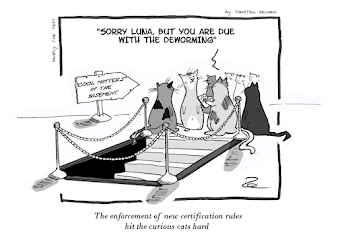
I don't know what came over me when I used "meow-meow" as the debugging text. Probably, Luna is to blame for it. Luna was our 16 year old cat which died shortly before. She's now eternalized in this (less testing related) cartoon.

We quickly found the cause for the missing signature, we fixed the bug and shipped it to the customer along with an updated template. Unfortunately, I forgot to remove the debugging text in the template. The customer found the problem during their internal BETA test. We fixed the template, shipped it, no big deal, over.

But, about half a year later, the customer reported that he'd seen a letter in the productive document management system containing the complimentary close "meow-meow" right below the printed signature.

I could feel my face becoming soaked with blood. How the heck could this happen again? Even though we don't execute all regression tests each time we ship a minor release or hotfix, the print-out is part of all smoke tests. Therefore, my thoughts were "this simply can't be true", 'cause we've never seen any such text being printed on any of the letters that ended on our printers.

A little investigation and it became soon clear what happened. Even though we had originally sent the correct template, there was still a copy of the old "meow-meow" template around. When someone decided to include the template into the git-repository, he took the wrong one. As a result, with the next minor software-version shipped, the old signature-template was deployed again. 

While this explains how the bug was re-introduced, it does not explain, why testers did not find the issue while testing the print-out. 

Further investigation revealed, even though ALL letters processed the "meow-meow" signature-template, NOT all letters were printing the text below the signature. We found out, it depended on several things such as the size of the signature and the configuration of the target letter being sent out. If there was a fixed size between signature and complimentary close, then the text "meow-meow" simply didn't make it in between and wasn't printed. If instead, the letter was configured to dynamically grow with the size of the signature, then also "meow-meow" made it to the printer.

Without going into too much details, only one particular type of letter was affected and fortunately, it was a letter that customers sent only to internal addresses (like an internal email) and not to stakeholders outside the company. Lucky me! 

Well, not really...because...

..one of the customers told me that - despite this letter is sent only internally - it may still be used as an enclosure for other letters going out to lawyers and doctors. The company feared they'd lose credibility when such letters made it to their customers. It was therefore important to remove all identified documents in production before they pay a high price for this slip.

What are the lessons learnt?
First of all, it could have been worse. I mean, if you get a letter that ends with "meow-meow", it's likely to put a smile on your face. In my 20 years career as a tester and developer, I've seen comments and debugging texts that are much worse and sometimes below-the line. My friends told me several stories about similar happenings. 

A colleague told me, they had added an exhilarant test-text for their ATM. The text was triggered when the card was about to get disabled. When in production - their boss wanted to withdraw money from the machine, the card got blocked and showed the text "You are a bad guy. That's why we take your card away". I only know, he wasn't amused about it. 

Looks like, we are not alone.

But, as we have just learnt, it depends on who is affected and who will read it. I can only suggest to never ever type anything like that in any of your tests because you never know where it's going to show up.

Instead of "meow-meow" a simple DOT or DASH would have done the same trick, and didn't raise the same kind of alarm in case such debugging messages make it to the bottom of a letter. 


This was the last cartoon and blog entry for 2021. There are more to come next year. Please excuse, this cartoon here wasn't a pure testing related cartoon, but the story still is.
I wish you all a merry XMAS and a happy new year. I hope you enjoy the blog and continue to regularly visit me here.


Monday, April 26, 2021

Esteem or Truth


At the drop of a hat, they decided to stay on the hazardous highway.

Sunday, March 14, 2021

Architecture Review

"Our architects recently studied all your ill-favored coding styles, but the good news are...we don't need any obfuscator tools anymore!"

Tuesday, January 5, 2021

No test is the same, use your brain

 About a decade ago, a manager wondered why I asked questions about how the software-under-test was supposed to work. He responded: "You don't need to know all that stuff, all you need to do is test".

This happened so many years back, I can't  remember whether he really meant it seriously or was he just making fun. 

I mention this episode here, because - even if you are looking at software from a black box or business oriented perspective, you should still be interested in how things work from a technical point of view.

If you are digging deeper into the entrails of a software-component, you are likely to find interesting information resulting in the detection/development of great new test cases.

James Bach (Satisfice) once provided a great example in one of his speaches when asking the audience "how much test cases do we need" while showing a diagram that consisted of a few simple rectangles and diamonds. Various numbers were summoned towards the speaker's desk, most of them being wrong or inappropriate. When James Bach revealed the details behind this simplified diagram, the scales fell from their eyes. It became clear that there is much more behind this graph. When people guessed numbers like 2, 3 or 5 tests, it became now clear, this was just the start and the real number of required tests would be multiple times higher than their first guess.

But, I have also my own story to share with you and demonstrate why it is important to ask more questions about the software-under-test.

A quick intro
Every passenger vehicle is registered using a 17-digit vehicle identification number (VIN) which is unique worldwide. The first 3 letters identify the manufacturer. 

For example:

  • WVWZZZ6NZTY099964 representing a 1994 a VW Polo
  • WF0WXXGBBW6268343 representing a 2006 Ford Mondeo V6
  • WBAPX71050C101516 representing a 2007 BMW 5series

In order to retrieve the details of each car's equipment such as painting color, 2-door, 4-door, tinted glass, sunroof, etc. we fired a VIN number as input and received the complete vehicle information as an XML output.

This service was an important part of a cloud based service we developed and sold as part of a bigger solution to insurance companies and bodyshops. The customers used it to estimate the total repair cost of damaged cars. Frankly speaking, in order to perform an accurate estimation, one needed at least the part prices and repair steps or workload. Our company was great in this business, since they had all that data from almost all car manufacturers. I have to admit, this is a simplified explanation of a more complex piece of software.

Back to testing
Our job was to make sure the vehicle identification service returns the correct car related data. To test that, we took our own and our friends' cars as a reference, because it was the easiest way for us to verify the data makes any sense. 

What we didn't know yet; our company wasn't the owner of all data. Depending on the manufacturer of the queried vehicle, our system either retrieved data from our own database or had to call a third party web service to request the required information. This was the case for BMW and PSA (Peugeot, Citroen, Opel, Vauxhall) just to name two examples.

For the end-user, this wasn't visible. All the user saw was a 17-digit VIN field with a button to trigger the search and then wait until we returned the complete vehicle information along with the equipment data.

What does that mean for the development of test cases?

Knowing, that the system - in some cases - communicates with third party components to get the information, is essential when testing this service. Simply submitting one VIN to see that the service responds correctly, is not enough.
We needed to know what data we own, and what data is gathered through calling external services. Unfortunately, we never managed to get a comprehensive list to shed a little light on the inwards of the software. Therefore, the only weapon for us testers was to test the service using a broard variety of exemplary VIN numbers covering as much as different manufacturers as possible.

But this is just half the story. When a request was being fired, our system cached the generated XML response for an unspecified period of time. 

That means, if you submit a particular BMW VIN number for the first time, followed by later calling that service again using the exact same VIN number, this wouldn't trigger the same developer's code paths anymore.

Also, we should know, for how long the data is cached. Unfortunately, the owners of the product didn't reveal the secret to the testers. I could now start with a new article on testability and rave over the necessity to have extra functions for testers to flush the cache when needed, but this goes beyond the scope of this article.

What else?

Having now two different kinds of tests such as...

- consider different brand names when testing VIN
- consider submitting the same VIN a second time to test the cache

..we should start thinking about what happens when one of the external services is unavailable.
How does our system react in such scenario, especially if the response isn't cached yet?
How would we even know that it's the external service and not our own code that got broken?

One of the approaches was to add extra tests examining the external services in isolation from our implementation.
Yet another approach - and this is what we did (because we were not given the details) - was to have a set or group of different VIN numbers that belong to the same manufacturer. For example, a set of 5 BMWs, another set of 5 Peugeots, 5 Fords, etc.

If an external service is down, then a whole set of such test cases would fail. If instead only 1 test within a set failed, then the root cause was probably somewhere else.

Visualized
The below circles demonstrate it visually. At the beginning one knows little to nothing about the system- or component-under-test (1). By questioning how things work, one detects new areas that may or may not be relevant while developing new test cases (2). Knowing and understanding these areas enlarge the awareness area of circle and result in minimizing the risk of skipping important test cases.

Closing rate
Developing test cases is not a monotonous job. The contrary is the case, it requires asking questions, sometimes critical questions and having a good understanding what are meaningful test scenarios to cover and which can be skipped without accepting high risks. Sometimes, you need to be obtrusive when it comes to interviewing techies to get the details, especially when asking for testability hooks.
Although testing activities face a lot of repeating patterns of software-defects, developing appropriate test cases is a task that involves a lot of thinking. That's why I say, no test is the same, use your brain!

BTW, I forgot to add...not all external service providers allowed us to cache data, even if it was cached just for one day. That's an additional test to think about, and I am sure, I forgot to mention many more tests we actually developed at that time.

 Below, find a simplified flowchart of the vehicle identification service.